
First a quick note:
ECEA thanks Senator Bright for being willing to pursue outside of the box ideas to fund child care with no new taxes. Senate Appropriations postponed SB26-180 indefinitely yesterday. So for now, cost avoidant measures are the only way to eventually get CCCAP stabilized and off of freezes.
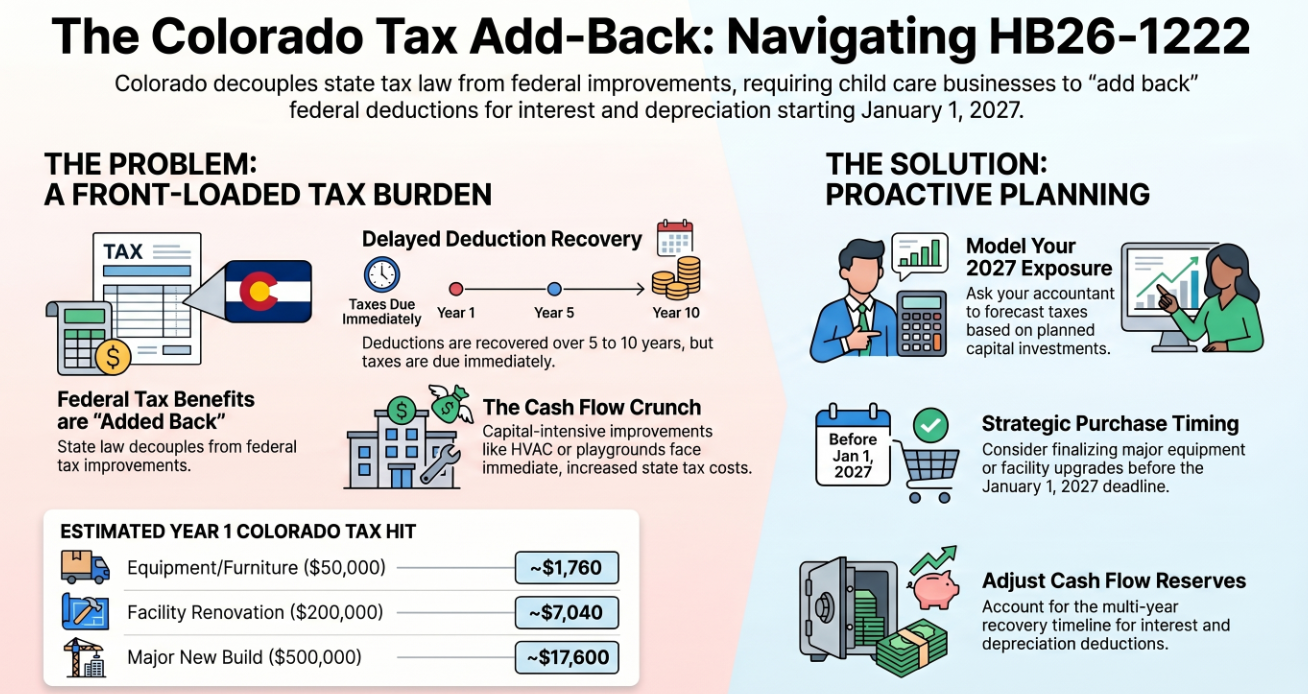
**speak to your accountant for specific impacts for your program.
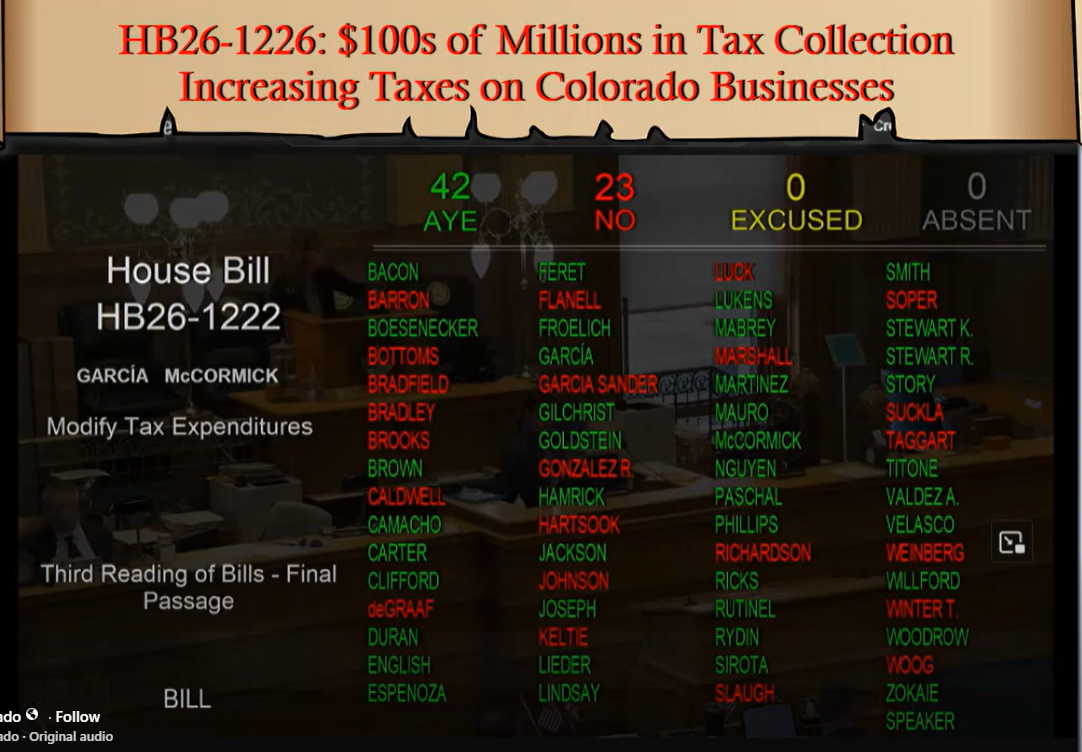
It's not just the Child Care Bills that impact your business
WHAT COLORADO HB26-1222 MEANS
FOR YOUR CHILD CARE BUSINESS
If you've been following the Colorado legislature this session, you may have heard about House Bill 26-1222, a tax bill that passed the House and is moving through the Senate. Its official title is dry. Its impact on your business is not.
Here's what you need to know, in plain language, before this takes effect on January 1, 2027.
THE SETUP: A FEDERAL TAX GIFT THAT COLORADO IS TAKING BACK
The federal government recently made several significant tax improvements for small businesses, the kinds of businesses that run child care centers. Specifically, they:
-
Expanded the business interest deduction, so businesses with loans can write off more of their interest costs.
-
Restored 100% bonus depreciation on property and equipment — meaning if you buy a new HVAC system, playground structure, or van, you could deduct the full cost in year one, rather than spreading it over many years.
-
Created a new immediate deduction for research and development expenses.
Because Colorado's income tax is calculated by starting with your federal taxable income, these federal deductions also lowered your Colorado state tax bill automatically. That was good news for your bottom line.
HB 26-1222 breaks that connection for the state. Starting in the 2027 tax year, Colorado will require businesses to add back those expanded federal deductions on their Colorado state return, effectively raising your Colorado taxable income and your Colorado tax bill.
WHAT GETS ADDED BACK — AND WHAT IT ACTUALLY COSTS YOU
There are four categories of deductions affected. Here's how each one plays out for a typical child care business:
1. Business Interest (Loans)
If your center carries a mortgage, SBA loan, equipment financing, or operating line of credit, you've been benefiting from an expanded interest deduction. Colorado will now limit that deduction back to pre-2025 levels. You'll recover the add-back in equal portions over five years — but you pay the tax now.
2. Bonus Depreciation on Equipment & Property
This is the one that hits hardest for most child care operators. Did you invest in a building renovation? New furniture? Kitchen equipment? A vehicle? Under federal law, you may have written off 100% of that cost in the year you bought it. Colorado will now add most of that deduction back — and you recover it in equal installments over ten years.
What does that mean in real dollars?
-
$50,000 equipment purchase → approximately $1,760 in added Colorado tax in year one
-
$200,000 facility renovation → approximately $7,040 in added Colorado tax in year one
-
$500,000 new build or major renovation → approximately $17,600 in added Colorado tax in year one
(Colorado's income tax rate is 4.4%. The recovery happens over 10 years but the cash hit is front-loaded.)
3. Production Property Depreciation
This provision covers manufacturing and production facilities. It is unlikely to affect most child care businesses directly.
4. Research & Development Expenses
Federal law now allows immediate expensing of domestic R&D costs. Colorado will add these back, recovered over four years. Most small child care providers don't carry formal R&D expenses, so the impact here is typically minimal.
THE REAL PROBLEM: A CASH FLOW CRUNCH AT THE WORST TIME
The legislature will tell you: "Don't worry, you get the deductions back eventually." And technically, they're right. But "eventually" is a cold comfort when you're running a child care center.
The businesses hit hardest are exactly the ones Colorado should be helping grow:
-
Centers that have recently invested or are planning to invest in building out, renovating, or expanding their facilities.
-
Operators carrying loans for necessary capital improvements to meet health, safety, or licensing standards.
-
Multi-site operators compounding the effect across several locations.
-
Pass-through businesses for S-corps, LLCs, sole proprietors where the tax hits the owner personally.
The child care sector already operates on razor-thin margins. Every capital investment is a carefully calculated risk. When you borrow to improve your facility or buy equipment under the assumption that you can deduct it upfront, and then like this summer with no tax on tips and no tax on overtime Colorado changes the rules. You pay the price for a policy decision you had no part in making.
THE OTHER SIDE: WHAT THIS BILL IS TRYING TO DO
We want to give you a complete picture because good advocacy is built on straightforward information.
The revenue generated by these business add-backs will fund a new Family Affordability Credit. This is a refundable tax credit targeted at lower- and moderate-income Colorado families with children. The bill is structured so the credit amount tracks the revenue raised from businesses.
For the families your members serve, that credit could mean more money available to pay for child care, if the family is not waiting for a CCCAP freeze to go away. That is genuinely good for our sector.
But the bill's own legislative declaration acknowledges that these deductions "disproportionately benefit large and capital-intensive businesses." The problem is that child care centers are also capital-intensive, not by choice, but by necessity. Playgrounds, commercial kitchens, HVAC systems, vehicles, licensed facilities. This is not luxury spending. It is the infrastructure of quality care. And this bill treats it the same as a manufacturing plant or a hedge fund's interest expense.
WHAT YOU SHOULD DO RIGHT NOW
This bill takes effect for tax year 2027, which means the clock is already running. Here's how to get ahead of it:
Talk to your accountant now: Share this article. Ask them to model your specific Colorado tax exposure for 2027 based on any capital investments you've made or are planning.
Rethink the timing of major purchases: If you're planning significant equipment or facility investments, the tax treatment at the state level is changing. A purchase made in 2026 vs. 2027 may have meaningfully different Colorado tax consequences.
Know your recovery timeline: Bonus depreciation add-backs are recovered over 10 years. Business interest add-backs over 5 years. Your deduction isn't gone, it's delayed. Plan your cash flow accordingly.
Stay connected with ECEA: We are tracking this legislation and its implementation. As the Department of Revenue issues guidance, we will translate it into action steps for our members. When the state decides to claw back business deductions to fund family credits, it must recognize that the small business owner who just financed a safe, quality learning environment for 40 children is not the same as a capital-intensive corporation seeking a tax advantage.
ECEA Members Minute (click here)
Member's ONLY content this week. If you click on the title and can't access the content below reach out to Dawn for support. If you haven't already looked at how to drive down your business costs to make room for the things you want and need to fund, reach out! Our partnerships can help you generate revenue and to stop overspending on services. They are business pivots that make sense.
- New business loans
- Legislative Tracker (session end next week)
- After session Ends watch for our industry voter guide where we tell you Who voted for the bills that help or work against your business!
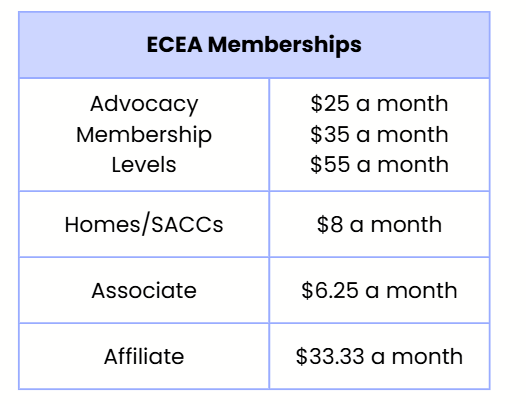
Join ECEA Now and Make a Difference!


Responses